
The Commercial Pilot’s Guide to Outthinking Your DPE During the Multi-Engine Add-On
- Jeff Gerencser
- May 4
- 5 min read

You’ve already checked the boxes. You have your Commercial Single-Engine Land (CSEL) certificate. You’ve logged the hours, mastered the maneuvers, and proven you can fly to professional standards. Now, you’re standing at the threshold of the Multi-Engine Add-On.
To most pilots, the multi-engine rating is seen as a "check-the-box" requirement for the airlines: a quick few days of flying and a checkride that mostly involves keeping the blue line on the airspeed indicator and not let the plane roll over when an engine quits. But if you walk into your checkride with that mindset, you are already behind the power curve.
To truly "outthink" a Designated Pilot Examiner (DPE), you have to move past the idea of being a student. You are a Commercial Pilot. The DPE isn't looking for someone who can recite the definitions of Vmc; they are looking for a Pilot in Command (PIC) who can manage a complex machine, anticipate aerodynamic changes, and demonstrate superior decision-making under pressure.
The PIC Mindset: Command Presence in the Cockpit
The biggest mistake pilots make during an add-on is treating it like a Private Pilot checkride. They wait for the DPE to give instructions, they react to emergencies instead of managing them, and they offer "textbook" answers that lack practical depth.
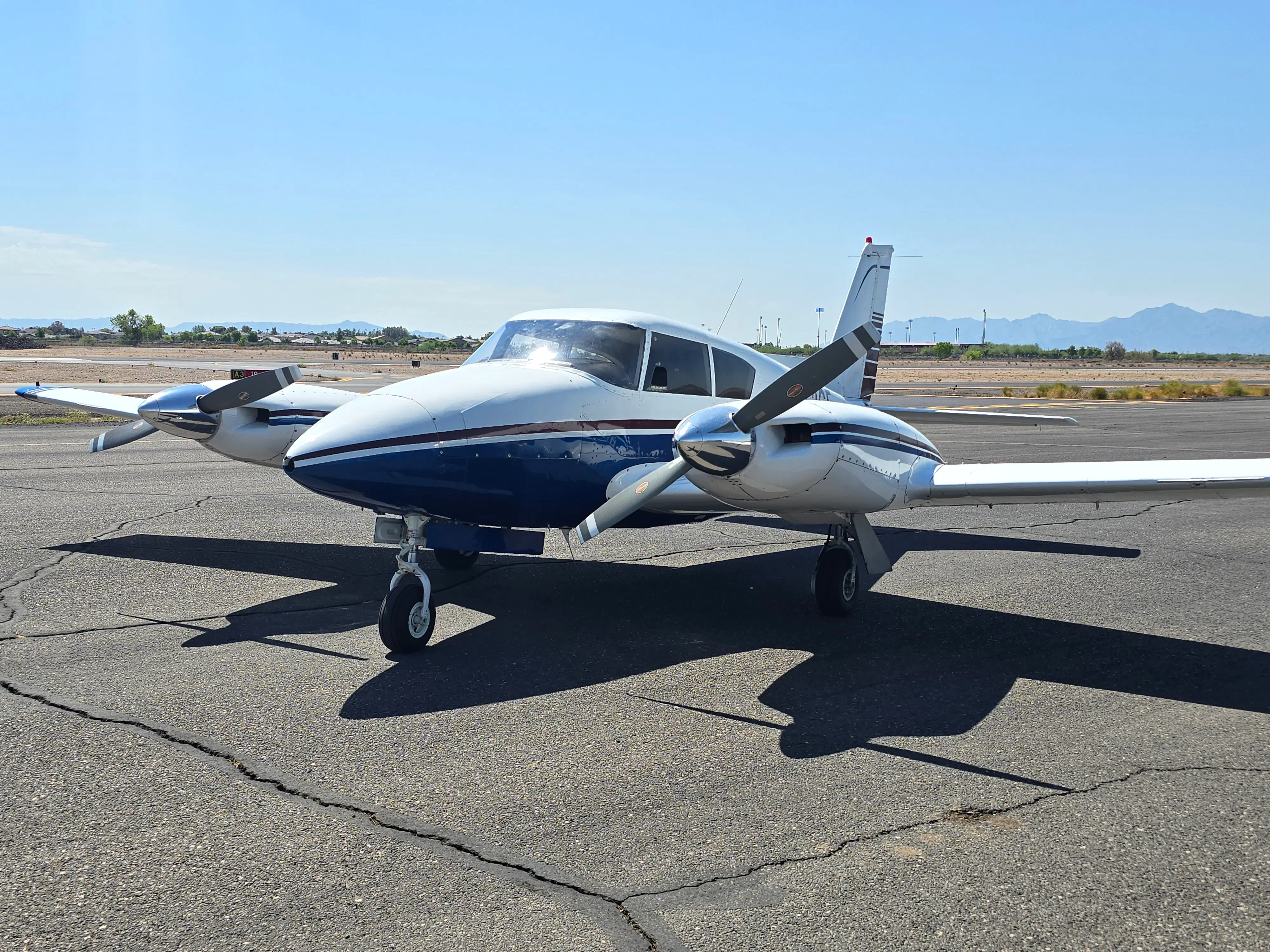
Outthinking the DPE starts with command presence. From the moment you begin the pre-flight, you need to own the aircraft. This means you aren't just checking oil levels; you are assessing the airworthiness of a multi-engine system. When you sit in the cockpit of the PA-30 Twin Comanche, the DPE should feel like a passenger on a professional flight, not an instructor hovering over a student.
Show the DPE you are thinking three steps ahead. Don't wait for the simulated engine failure to talk about your plan. Brief your takeoff with multi-engine specific contingencies: "If we lose an engine before Vr, we abort. If we lose it after Vr with gear down, we land on the remaining runway. If the gear is up, we identify, verify, and feather while maintaining blue line."
Systems: Stop Memorizing, Start Visualizing
A common pitfall in the multi-engine oral is rote memorization. A DPE can tell within thirty seconds if you’ve just memorized a flashcard or if you actually understand how the fuel flows through the selectors.
In a Twin Comanche, you aren't just dealing with "an engine." You are dealing with systems that interact. You need to understand the Turbocharger Systems if equipped, the constant-speed propellers, and the complex fuel crossfeed system.
When the DPE asks about an engine failure, don't just talk about the dead engine. Talk about the remaining engine. What are its limitations? How does the load change on the alternator? How does the heater (often located in the nose or powered by a specific side) impact your decision-making if you’re in IMC?
Mastery of the Multi-Engine Training Series isn’t about passing a test; it’s about having a mental model of the aircraft so vivid that when a gauge flickers, you already know which system is failing before the DPE even covers the tachometer.
Energy Management and the Physics of Flight
In a single-engine plane, altitude is your primary bank account of safety. In a multi-engine plane, your bank account is a combination of altitude and airspeed: specifically, your relationship with Vyse (Blue Line) and Vmc.
To outthink the DPE, you must demonstrate a deep understanding of Forces acting on an aircraft. During the flight portion, the DPE will be watching your feet. They want to see that you understand the yawing and rolling moments associated with asymmetrical thrust.
One of the best ways to impress a DPE is through proactive energy management. Don't just "fix" a speed deviation; narrate why it’s happening. "I’m seeing a slight decay in airspeed due to the increased drag in this turn; I’m adding a touch of power to maintain our blue line." This shows you aren't just reacting to the needle; you are managing the energy state of the aircraft.
Understanding the Critical Engine isn't just a theoretical exercise for the oral exam. It’s a physical reality you should be able to feel in the air. When you demonstrate Vmc maneuvers, you aren't just looking for the stall or the loss of directional control; you are demonstrating that you understand exactly where the "edge" is and how to stay safely away from it.

The PA-30 Twin Comanche: The Ultimate Proving Ground
At Ace Pilot Academy, we use the Piper PA-30 Twin Comanche for a reason. While some schools use sluggish, underpowered trainers that forgive a lot of sloppy pilot work, the Twin Comanche is a "pilot's airplane." It’s fast, it’s responsive, and it rewards precision.
If you can fly a Twin Comanche to ACS standards, you can fly anything. The Twin Comanche forces you to stay ahead of the airplane. Because it’s a high-performance machine, things happen faster. This is actually an advantage during a checkride. When you show the DPE you can handle the speed and complexity of the PA-30 with a G1000 glass cockpit, you are implicitly telling them you are ready for a regional jet or a high-end charter turboprop.
The DPE wants to see that you can manage the automation without being a slave to it. Use the G1000 to increase your situational awareness, not as a crutch to replace your basic stick-and-rudder skills.
Mastery of the ACS (Airman Certification Standards)
The ACS is not a "ceiling" to reach; it’s the absolute floor. If you want to outthink your DPE, your goal should be to fly well within the tolerances. If the ACS allows +/- 100 feet on an altitude, your personal standard should be +/- 20 feet.
When you perform the maneuvers: whether it’s Steep Turns, Slow Flight, or the dreaded Engine Out: do them with a sense of "deliberate execution." This means:
Clear the area.
Configure the aircraft.
Verbalize the goal.
Execute smoothly.
Recover decisively.
During the simulated engine failure on takeoff or in flight, the DPE is looking for your "Flow." A professional pilot doesn't fumble. They identify, verify, and feather with a calm, rhythmic motion. This "flow" is what separates a commercial candidate from a private pilot.

High-Stakes Decision Making
The final way to outthink the DPE is to demonstrate that you are a "Safety First" pilot, even when it’s inconvenient. If the weather is marginal, or there’s a minor maintenance discrepancy, don't wait for the DPE to say something. You be the one to bring it up.
"The crosswind component is gusting right at our limits. As a professional, I’m evaluating whether this is the best environment for this checkride."
DPEs love this. It shows that you aren't just "test-hungry": you are a risk manager. This is the hallmark of the Commercial Pilot.
Beyond the Checkride
The Multi-Engine Add-On is often the final "learning" rating before a pilot moves into the world of time-building and professional employment. It’s the bridge between being a student and being a peer to the person sitting in the other seat.
By focusing on mindset, energy management, and systems mastery, you aren't just preparing for a checkride; you are preparing for a career. When you step into the PA-30 cockpit at Ace Pilot Academy, you aren't just adding a rating to your plastic card. You are proving that you have the mental discipline and technical skill to command a multi-engine aircraft in any condition.
Don't just aim to pass. Aim to be the pilot the DPE remembers as the most prepared candidate they’ve seen all year. That is how you outthink the checkride.
Ready to level up? Explore our Multi-Engine Training Series and get the specialized knowledge you need to master the Twin Comanche and ace your add-on.

Comments