
7 Mistakes You’re Making on Your Multi-Engine Checkride (and How to Fix Them)
- Jeff Gerencser
- Apr 3
- 4 min read

Welcome to the wrap-up of our Multi-Engine Mastery Week here at Ace Pilot Academy. Over the last few days, we’ve broken down everything from V-Speeds to the intricacies of the Twin Comanche and the grind of time building. Today, we’re finishing strong by focusing on the finish line: the Commercial Multi-Engine Add-On Checkride.
Moving from a single-engine aircraft to a twin is a massive milestone in a professional pilot’s career. It’s not just about more horsepower; it’s about managing complexity, asymmetrical thrust, and a significantly higher workload. Even the most seasoned commercial pilots stumble during this checkride because they treat the twin like a "heavy Cessna 172."
Based on FAA Airman Certification Standards (ACS) and common feedback from Designated Pilot Examiners (DPEs), here are the seven most common mistakes pilots make on their multi-engine checkride and exactly how to fix them.
1. Mixing Up Your Multi-Engine V-Speeds
This is the number one area where applicants lose points before the wheels even leave the pavement. During the oral exam and the flight, precision is everything. If the DPE asks for $V_{yse}$ and you give them the number for $V_{mc}$, you’ve already signaled a lack of preparation.
The Fix: You must memorize your V-speeds for the specific aircraft you are flying: not just the numbers, but the definitions and the "why" behind them.
$V_{mc}$ (Minimum Control Speed): The speed below which directional control cannot be maintained with the critical engine inoperative.
$V_{yse}$ (Best Rate of Climb Single-Engine): Marked by the "Blue Line" on your airspeed indicator.
If you need a refresher on how these speeds are calculated and what factors affect them, check out our Multi-Engine V-Speed course.
2. The "Dead Foot, Dead Engine" Hesitation
When an engine "fails" (or the DPE pulls a throttle), the clock starts. A common mistake is rushing the identification process or, conversely, freezing up. Identifying the wrong engine and feathering the working one is an immediate "discontinued" or "failed" ride.
The Fix: Adopt a disciplined, rhythmic flow.
Maintain Directional Control: Use the rudder to stop the yaw.
Identify: "Dead foot, dead engine." If you are pushing with your right foot to keep the nose straight, the left engine is the one that has failed.
Verify: Retard the throttle of the suspected dead engine. If nothing changes, you’ve identified it correctly.
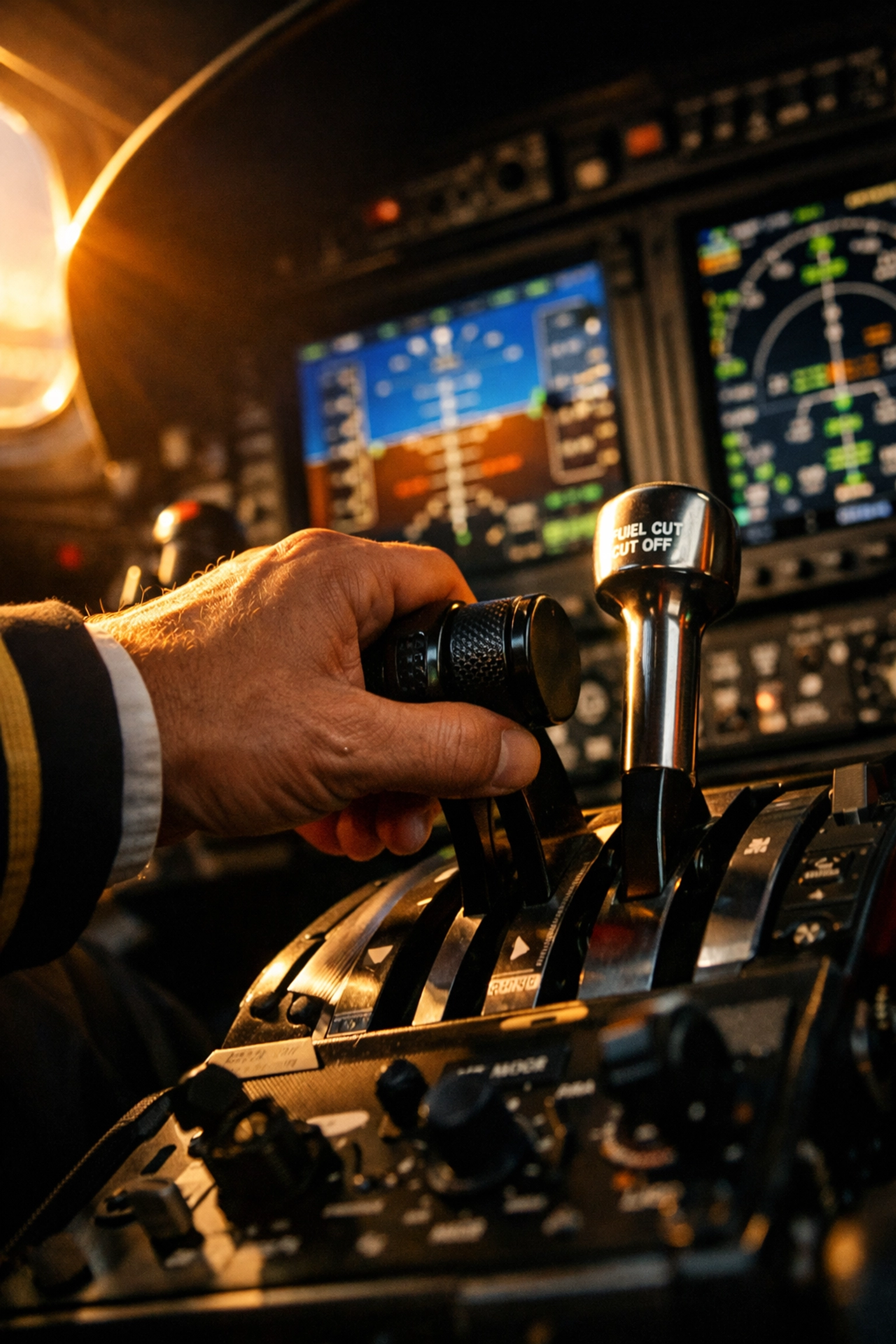
Caption: A disciplined cockpit flow is essential during simulated engine failures to avoid "feathering the wrong one."
3. Fighting the Rudder (Ignoring Zero Side Slip)
Many pilots keep the ball centered in the turn coordinator during single-engine flight. In a twin-engine aircraft with one engine out, a centered ball actually creates massive amounts of drag because the fuselage is "slipping" through the air.
The Fix: You need to establish a Zero Side Slip condition. This typically involves:
Banking: 2 to 5 degrees into the operative engine.
Rudder: Use enough rudder so the ball is about half to one full width toward the operating engine.
This configuration aligns the fuselage with the relative wind, reducing drag and giving you the best possible climb (or least possible descent) performance. Without it, you are fighting a losing battle against aerodynamics.
4. Poor Systems Knowledge: The "Why" Behind the Maneuver
DPEs aren't just looking for you to move levers; they want to know if you understand the machine. A frequent mistake is failing to explain the Critical Engine or how the Propeller Systems actually work. If you don't know why your prop feathers (nitrogen charge vs. oil pressure), you won't know how to troubleshoot a real-world malfunction.
The Fix: Treat the systems manual like the Bible. You should be able to draw the fuel system, explain the Fuel Crossfeed procedures, and describe the Cowl Flap operation for cooling during high-power climbs.
5. Forgetting Basic Airmanship (The "Multi-Engine Fog")
It’s ironic, but commercial-grade pilots often fail multi-engine rides because they forget Private Pilot basics. Research shows that applicants often forget to get ATIS, fail to perform clearing turns before maneuvers, or miss radio calls because they are so hyper-focused on the second engine.
The Fix: Use your checklists, but don't bury your head in them. For routine items like taxiing or pre-landing, use a "Flow then Check" method. Set your cockpit, then verify with the printed checklist to ensure nothing: like the ATIS or a landing gear extension: was missed.
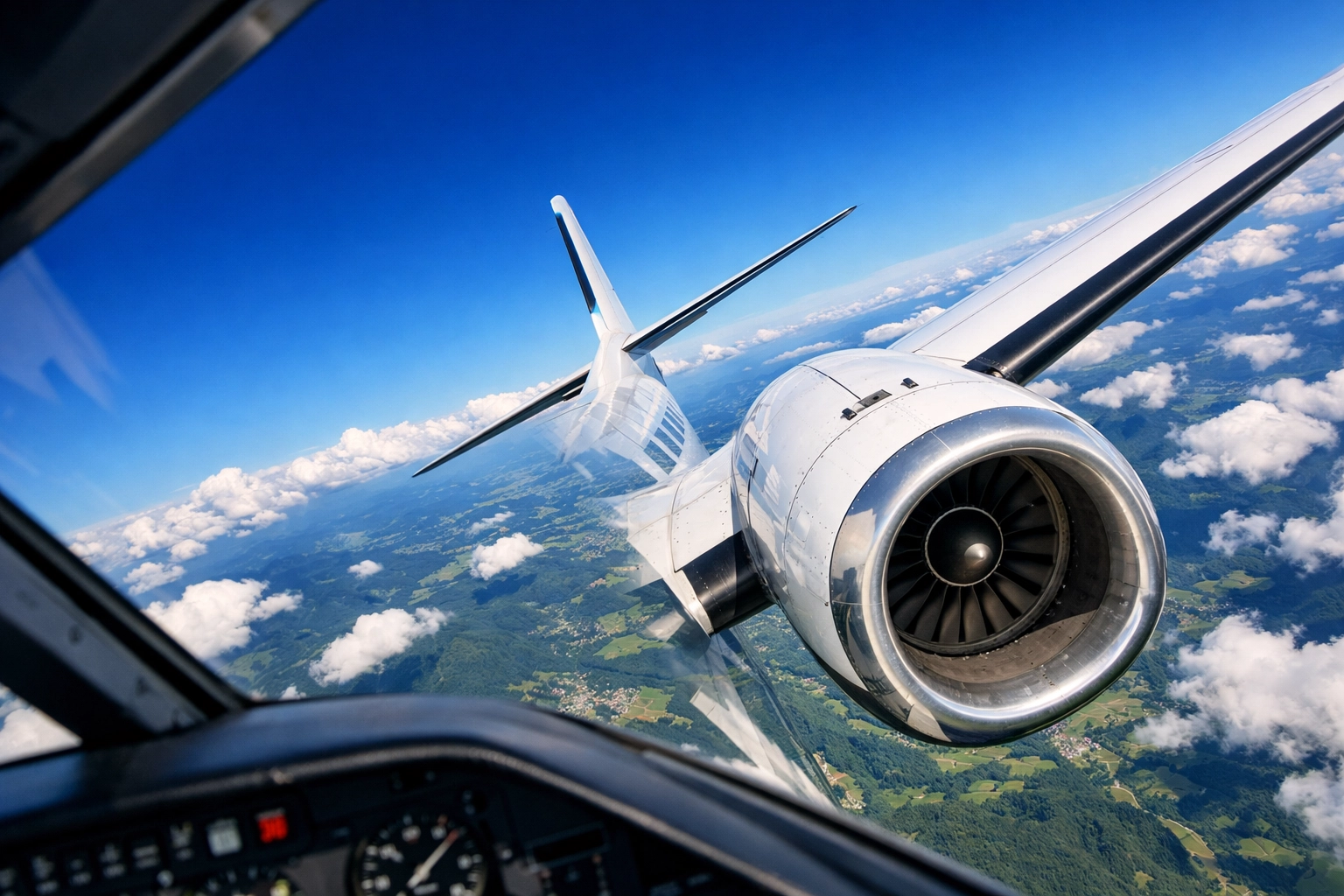
Caption: Even in complex aircraft, basic airmanship: like looking outside and clearing the area: remains the priority.
6. Failing the Engine Restart
If your checkride includes a literal engine shutdown and feathering (which many do), the restart is a high-stakes moment. If the engine doesn't come out of feather or fails to start because you missed a step in the restart flow, the ride is usually over.
The Fix: Practice the air-start procedure until it is muscle memory.
Ensure the fuel selector is on.
Check that the magnetos/ignition are on.
Follow the manufacturer's recommended airspeed for the "unfeathering" process.
Don't shock-cool the engine: Once it starts, let it warm up at a low power setting before slamming the throttle forward.
Check the Multi-Engine Performance and Limitations guide to understand the envelope for safe air-starts.
7. Drag Management and Gear Extension
In a single-engine emergency in a twin, "Drag is the Enemy." A common mistake is dropping the landing gear too early. In many light twins, if you put the gear down while flying on one engine, you will no longer be able to maintain altitude.
The Fix: Commit to the "Gear Down" decision only when landing is assured. If you are on an instrument approach on one engine, do not drop the gear at the Final Approach Fix (FAF) unless you are certain the aircraft can handle the drag profile for the remainder of the descent. Understand how Ground Effect might trick you into thinking you have more performance than you actually do during the flare.
Final Thoughts for the Checkride
The Multi-Engine checkride is a test of your transition from a pilot to a Systems Manager. The DPE wants to see that you can stay ahead of the airplane, even when half of your power is gone and the workload is doubled.
If you’ve been following our Multi-Engine Mastery Week, you already have the tools. Now, it’s about execution. Stay calm, follow your flows, and remember: Fly the airplane first.
Ready to ace your checkride? Deepen your knowledge with our comprehensive Multi-Engine Training Series. We cover everything from $V_{mc}$ aerodynamics to advanced systems management, ensuring you walk into that checkride with total confidence.
Fly safe, fly precise, and we'll see you in the cockpit.

Comments