
7 Mistakes You’re Making with Your Multi-Engine Add-On Checkride (and How to Fix Them)

The multi-engine add-on is often the most exciting rating a pilot pursues. It represents a transition from single-engine simplicity to the complex world of professional aviation. However, many candidates approach the checkride with a "private pilot" mindset, leading to avoidable errors that can result in a notice of disapproval.
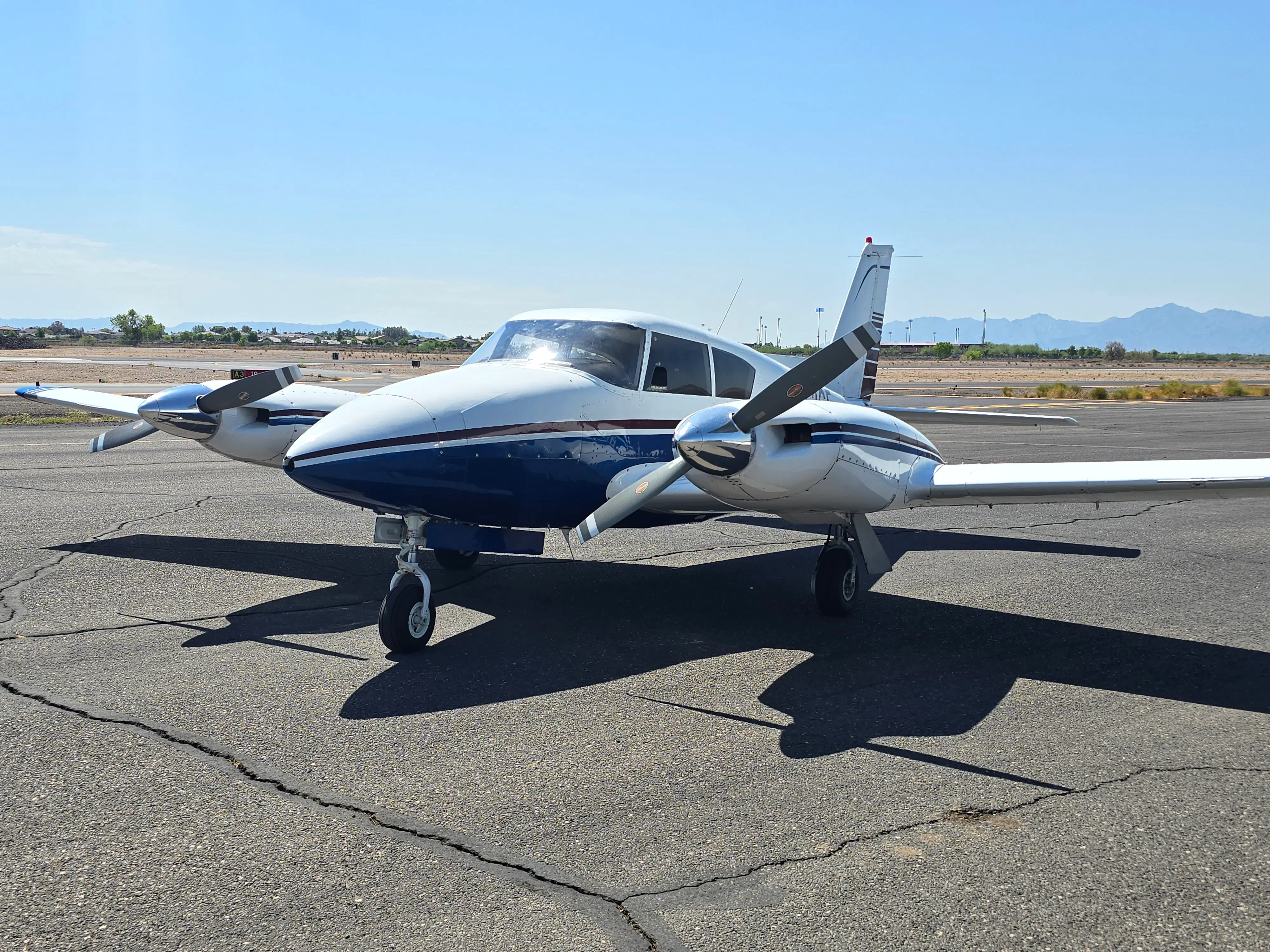
At Ace Pilot Academy, we see students transition through our Multi-Engine Training Series daily. Based on FAA Airman Certification Standards (ACS) and thousands of hours of dual instruction in our PA-30 Twin Comanche, we have identified the seven most common pitfalls.
Here is how to avoid them and secure your multi-engine rating.
1. The Vyse Trap: Allowing Airspeed to Bleed
The most critical speed in any light twin is Vyse: the best single-engine rate of climb speed, indicated by the blue line on your airspeed indicator. During an engine-out scenario, failing to maintain this speed is the fastest way to fail a checkride.
The Mistake: Pilots often get "target fixated" on the failed engine and allow the nose to pitch up, causing airspeed to decay below the blue line. If you fall below Vyse while single-engine, your climb performance evaporates, and you risk entering the Vmc (Minimum Control Speed) danger zone.
The Fix:
Pitch for Blue Line: The moment an engine fails, your primary flight control input must be to establish the pitch attitude for Vyse.
Trim Immediately: Use rudder trim to take the heavy load off your leg so you can focus on precise pitch control.
Standardization: Review the Multi-Engine V-Speeds and understand exactly where your aircraft performs best under various weight and balance configurations.
2. Identifying the Wrong Engine ("Dead Foot, Dead Engine")
Under the stress of a simulated engine failure, the brain sometimes takes shortcuts that lead to disastrous decisions.
The Mistake: Relying solely on engine instruments (like manifold pressure or tachometer) to identify which engine has failed. In some failure modes, like a catastrophic internal failure, instruments may still show "normal" readings for several seconds while the thrust is gone.
The Fix:
Feel the Aircraft: Use the "dead foot, dead engine" rule. If you are pushing hard with your right foot to keep the ball centered, the left engine is the one that has failed.
The Identification Flow:
3. Reading Maneuvers Instead of Performing Them
The multi-engine add-on checkride is a practical test of proficiency. A Designated Pilot Examiner (DPE) expects you to have memory items internalized.
The Mistake: Pulling out a checklist or a manual in the middle of a Vmc demonstration or an emergency engine-out flow. While checklists are vital for "clean-up" and "securing," the initial emergency response must be instinctive.
The Fix:
Commit to Memory: Emergency flows (Identify, Verify, Feather, Secure) must be performed from memory.
Chair Fly: Spend time in the cockpit or at home visualizing the switches. You should be able to touch every lever: throttle, prop, and mixture: without looking.
ACS Compliance: Ensure your memory items align exactly with the FAA Airplane Flying Handbook guidance.
4. Misunderstanding Multi-Engine Aerodynamics
DPEs love to dig into the "why" during the oral portion and the flight. If you can't explain why one engine is "critical," you aren't ready for the checkride.
The Mistake: Giving a rote definition of a Critical Engine without being able to explain the four factors (P-Factor, Accelerated Slipstream, Spiraling Slipstream, and Torque).
The Fix:
Master the "PAST" Acronym: Be able to draw diagrams of how P-factor creates a longer arm on the right engine (in a non-counter-rotating twin), leading to a greater yawing moment.
Know Your Systems: Understand how the constant-speed, full-feathering propellers on the PA-30 actually work. Explain the role of nitrogen charge, oil pressure, and centrifugal feathering latches.

Caption: A detailed look at the aerodynamic forces during asymmetrical thrust.
5. Poor Communication with the DPE
A checkride is a managed flight. If the DPE doesn't know what you are doing, they will assume you don't know either.
The Mistake: Failing to brief the DPE on your intentions during simulated emergencies. For example, if you plan to simulate a feathering but the DPE expects a full feather, the discrepancy can lead to a safety issue or a failure.
The Fix:
The Pre-Maneuver Brief: Before every maneuver, state: "I am going to perform the Vmc demonstration. I will recover at the first sign of loss of directional control or the stall horn, whichever comes first."
Verbalize Everything: "I am identifying the left engine is dead. I am verifying by pulling the left throttle. I am simulating feathering the left propeller." This removes all doubt from the examiner's mind.
6. Over-reliance on Technology (G1000 Blindness)
Modern avionics are a blessing, but they can be a curse during a checkride if you lose "outside-the-cockpit" situational awareness.
The Mistake: Spending too much time looking at the G1000 or the iPad while trying to troubleshoot an engine issue. This leads to altitude deviations and heading drifts that exceed ACS standards.
The Fix:
Fly the Airplane First: In a multi-engine aircraft, directional control is your number one priority.
Scan Management: Use the G1000 Glass Cockpit for data, but keep your primary scan outside or on the backup instruments.
System Knowledge: Understand how your specific avionics suite displays engine data. Do you know where the fuel flow indicators are located in relation to the EGT?
7. The Failed Go-Around Logic
The single-engine go-around is one of the most dangerous maneuvers in a light twin.
The Mistake: Attempting a single-engine go-around when the aircraft is already "low and slow" on short final. In many light twins, a single-engine go-around is physically impossible once the gear and flaps are down and the aircraft has descended below a certain altitude.
The Fix:
Commitment Point: Establish a "decision height" for your single-engine approach. If you are not stabilized by 400 feet AGL, you must make a decision.
Declare It: If you realize the approach is bad, verbalize it. "The approach is unstabilized; I am executing a single-engine go-around while I still have the altitude and airspeed to do so safely."
ACS Reality: Understand that the ACS evaluates your decision-making. Sometimes, the "right" answer in a real-world engine failure on short final is to put the aircraft on the ground (or even the grass) rather than attempting a go-around that results in a Vmc roll.
How to Prepare for Success
The multi-engine add-on is a "short" course, often completed in just a few days. This speed can be a double-edged sword. While Accelerated Flight Training is efficient, it requires intense focus.
The Ace Pilot Academy Checklist for Checkride Day:
Weight and Balance: Have a pre-calculated W&B for yourself and the examiner. Know how the CG shifts as fuel is burned.
Performance Calculations: Know your single-engine service ceiling for the current density altitude. If the service ceiling is 3,000 feet and you’re at 4,000 feet, tell the examiner you cannot maintain altitude single-engine today.
The "Slow-Down" Rule: Multi-engine airplanes move faster. Give yourself more room for the pattern. Don't rush your flows.
Stay Proactive: Don't wait for the engine to fail. Always be thinking: "If it quits right now, where am I going?"
By avoiding these seven common mistakes, you demonstrate more than just "flying skill": you demonstrate the command authority and systems knowledge required of a multi-engine pilot.
Ready to take the next step in your career? Check out our Multi-Engine Time Building tips to see how to leverage your new rating into a professional cockpit.

Caption: A candidate and instructor conducting a pre-flight briefing at Ace Pilot Academy.

Comments