
5 Steps to Ace Your Commercial Multi-Engine Add-On Checkride (The Practical Guide)

Welcome to the final installment of Multi-Engine Mastery Week. Over the last few days, we’ve broken down V-speeds, explored the nuances of the Piper PA-30 Twin Comanche, and debated the merits of accelerated training. Today, we focus on the finish line: the Commercial Multi-Engine Add-On Checkride.
For the career-focused aviator, this rating is a gateway to the airlines, corporate flight departments, and cargo operations. Unlike your initial private or commercial certificates, the multi-engine add-on is less about learning how to fly and more about learning how to manage a complex machine when things go wrong. The FAA examiner isn't looking for "passable" maneuvers; they are looking for a PIC who demonstrates mastery of asymmetric thrust and systems management.
Here are the five practical steps you need to follow to secure your certificate.
Step 1: Become a Systems Expert
The multi-engine oral exam is notoriously systems-intensive. Because you are likely adding this rating to an existing commercial single-engine certificate, the examiner will skip basic regulations and focus almost entirely on the aircraft's mechanics. You must move beyond rote memorization and achieve a deep, functional understanding of how the multi-engine flight training aircraft operates.
Focus your study on these specific areas:
Constant-Speed Feathering Propellers: Understand the role of nitrogen charges, hub springs, and counterweights. You should be able to explain exactly why the prop feathers when oil pressure is lost and what prevents it from feathering during a normal engine shutdown on the ground (the centrifugal start pins).
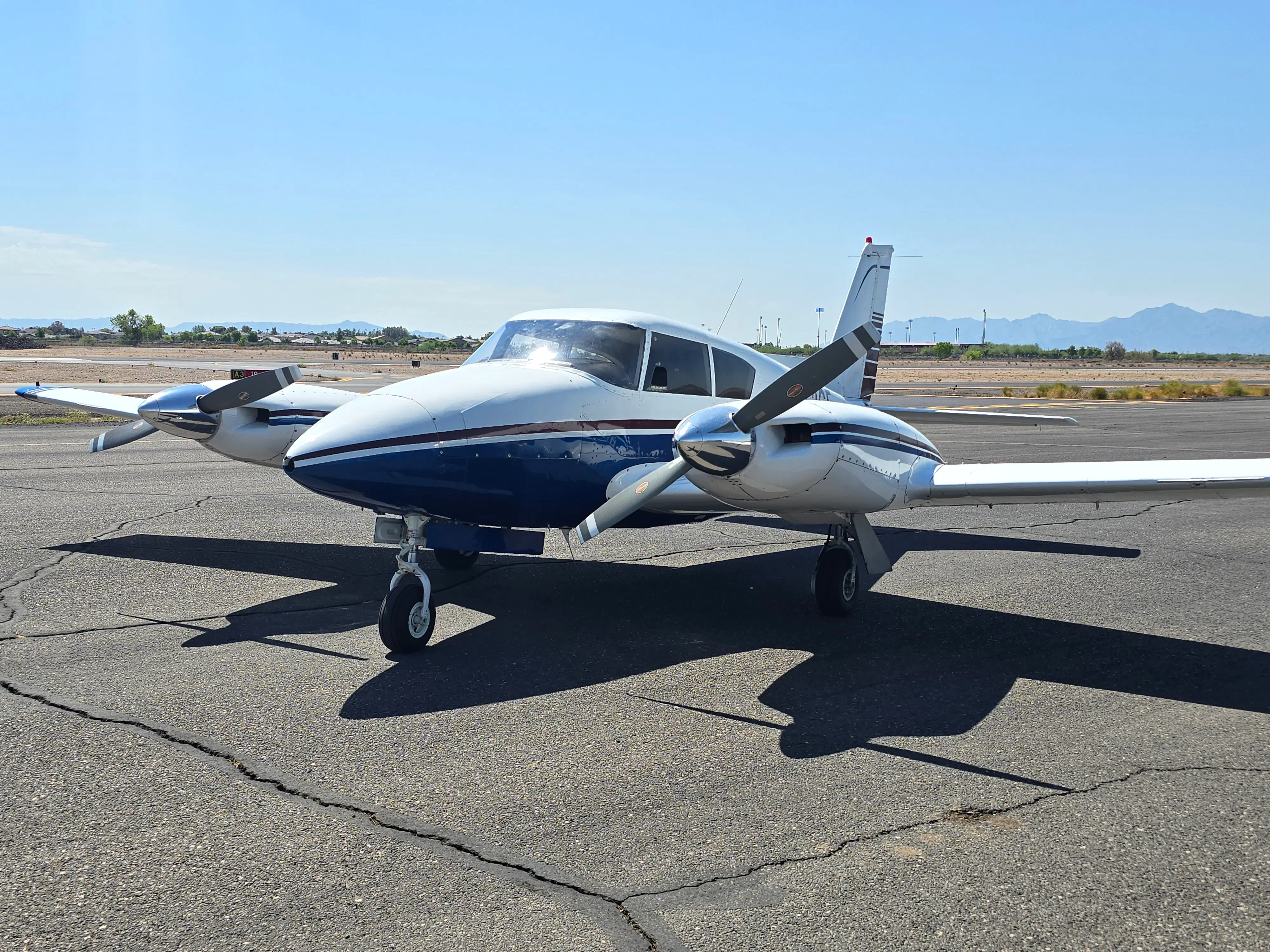
Landing Gear Logic: If you’re training in our PA-30, know the electrical and mechanical components of the gear system. Be prepared to explain the emergency extension procedure in detail.
Fuel System: Multi-engine fuel systems are more complex than those in a Cessna 172. Know the locations of pumps, crossfeed capabilities, and how to prevent fuel starvation during asymmetric flight.
Electrical System: Identify the number of alternators, batteries, and the load distribution. If one alternator fails, what equipment stays online?
Step 2: Master the Aerodynamics of Asymmetric Thrust
You cannot pass a multi-engine checkride without a complete grasp of Vmc (Minimum Controllable Airspeed). The examiner will expect you to define it, list the factors that affect it, and explain why those factors matter.
In the multi-engine flight training course, we emphasize the "SMACFUM" acronym to help students remember the 12 factors used by manufacturers to determine Vmc under 14 CFR Part 23. However, on the checkride, simply listing them isn't enough. You must be able to explain the "why." For example, why does a forward Center of Gravity (CG) decrease Vmc? (Answer: It increases the lever arm of the rudder, making it more effective at countering yaw).
Key aerodynamic concepts to master:
The Critical Engine: Understand the four factors (PAST: P-factor, Accelerated slipstream, Spiraling slipstream, and Torque) that make the left engine critical on most conventional twins.
Zero Side Slip: Learn to recognize the correct bank angle (usually 2° to 5°) and ball displacement (about half a ball width) required to minimize drag and maximize performance during single-engine flight.
Performance Loss: Remember that losing one engine on a light twin doesn't just mean losing 50% of your power: it can mean losing 80% to 90% of your climb performance due to the massive increase in drag.

Step 3: Perfect Your Flow Patterns and Muscle Memory
The cockpit of a multi-engine aircraft is a high-workload environment, especially during an engine failure. You do not have time to hunt for switches or refer to a checklist during the initial "critical" phase of an emergency.
Success on the checkride depends on your ability to execute "flows": standardized patterns of movement across the cockpit: followed by a checklist to verify your actions.
The Engine Failure Drill:
Control: Maintain directional control with the rudder and pitch for Vyse (Blue Line).
Power: Mixtures, Props, and Throttles full forward.
Drag: Flaps up, Gear up.
Identify: "Dead foot, dead engine."
Verify: Retard the throttle of the suspected dead engine.
Fix or Feather: Depending on altitude and situation, either attempt a restart or feather the prop and secure the engine.
Practice these flows on the ground until they are automatic. If you are using modern avionics, ensure you are proficient with the PA-30 G1000 Cockpit layout. Knowing exactly where your engine instruments are located will save you precious seconds when identifying a power loss.
Step 4: Execute Single-Engine Operations with Precision
The flight portion of the checkride focuses heavily on your ability to handle the airplane with one engine "inoperative" (simulated by the examiner). You must be prepared for the examiner to pull a throttle at any moment: during takeoff roll, on the initial climb, or during a steep turn.
Critical Maneuvers to Review:
Engine Failure During Takeoff (Below Vmc/Vr): This is a "power idle, maintain centerline, stop on the runway" maneuver. Do not try to fly.
Engine Failure After Takeoff: If the gear is still down and you have runway remaining, land. If you are "cleaned up" and have sufficient altitude, execute the climb-out at Vyse.
Vmc Demonstration: This is often the most nerve-wracking maneuver. The goal is to demonstrate the loss of directional control and the proper recovery. Remember: the first sign of either a stall or loss of directional control is the signal to recover. Recover by reducing power on the operating engine and decreasing the angle of attack.
Instrument Approach on One Engine: You must be able to fly a precision or non-precision approach while managing the asymmetrical thrust. Small, smooth power adjustments are key to staying on the glideslope.

Step 5: Train to the Airman Certification Standards (ACS)
The FAA Airman Certification Standards (ACS) is the "cheat sheet" for your checkride. It outlines exactly what the examiner will test and the tolerances you must maintain. For a Commercial Multi-Engine Add-On, the tolerances are tight.
Common ACS Pitfalls:
Altitude and Heading: You are generally expected to maintain altitude within +/- 100 feet and headings within +/- 10 degrees. During single-engine operations, these tolerances become more challenging but remain the standard.
Airspeed Management: On a single-engine approach, dropping below Vyse (Blue Line) is a major error. Treat Blue Line as your minimum speed until the landing is assured.
Checklist Usage: Many pilots fail because they rely solely on memory and forget to "clean up" the airplane. Always verify your flows with the physical or electronic checklist.
Clearing Turns: Never begin a maneuver without performing clearing turns. It is a basic requirement that many experienced pilots overlook during the stress of a checkride.
Before your scheduled date, perform a full mock checkride with an instructor who hasn't been your primary trainer. This provides an objective look at your performance and helps identify "plateaus" in your learning. If you are traveling for your training, check out our about us page to see how our instructors prepare students for high-success rates.
Final Prep: The Paperwork and Environment
The checkride starts long before you preflight the plane. Ensure your IACRA application is correct and that you have all the required endorsements in your logbook. Verify that the aircraft maintenance logs are in order: the examiner will likely ask you to prove the aircraft is airworthy by showing the annual, 100-hour, transponder, and pitot-static inspections.
If you’re ready to take the next step in your aviation career, contact us today to schedule your multi-engine training block. Whether you are aiming for a regional airline seat or looking to fly your own twin, precision and preparation are the only ways to "ace" the ride.
For more information on our specific curriculum, visit our online aviation training course portal or view our full list of offerings at the courses archive.
Fly safe, stay on the Blue Line, and we'll see you in the cockpit.

Comments